Skip to content

Cold outreach has earned a bad reputation for a pretty understandable reason: a lot of it is bad.
Connect. Pitch. Follow up. Pitch again. Repeat until the prospect responds—or starts wondering where the block button went.
But effective LinkedIn outreach for agencies can look very different.
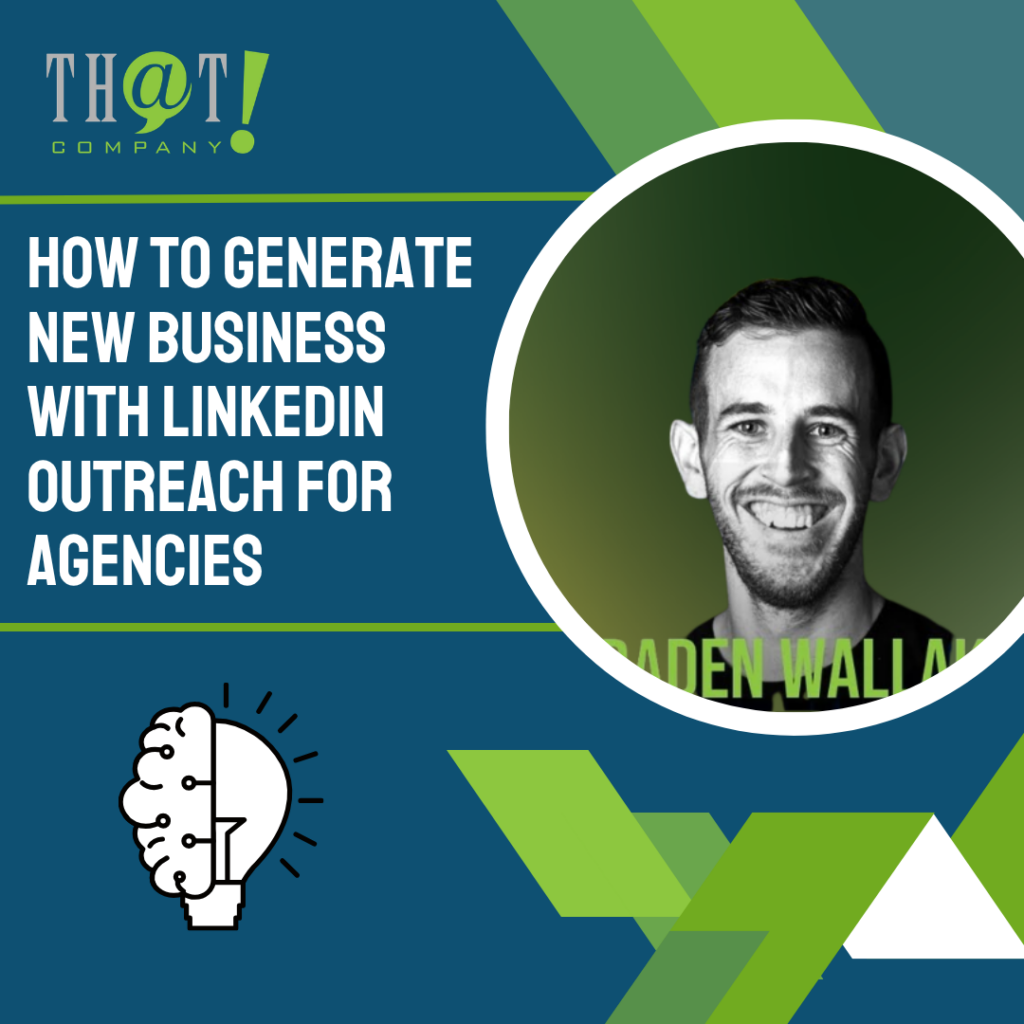
In a That! Company Agency Owner Mastermind session, Braden Wallake, CEO of HyperSocial, shared the strategies his team has used to generate B2B conversations through LinkedIn. His approach centers on building relationships first, providing value before asking for a sale, and using automation without making outreach feel robotic.
If you prefer to watch the conversation, check out the video below. Otherwise, here are the biggest lessons agency owners can put to work.
Why LinkedIn Outreach Works Differently When You Lead With Value
One of the biggest themes from Wallake’s presentation was simple: stop treating every new LinkedIn connection like an immediate sales opportunity.
He refers to the connect-and-immediately-pitch approach as “pitch slapping.” Anyone who spends much time on LinkedIn has probably experienced it.
A connection request arrives. You accept it. Seconds later, there is a paragraph in your inbox explaining someone’s service, calendar availability, life story, and possibly their hopes and dreams.
Instead, Wallake recommends beginning with a genuine connection and creating a reason for the prospect to continue the conversation.
One agency example he discussed used a remarkably simple first message after connecting:
“Thanks, glad we got connected. Let me know if I can support your business in any way.”
There’s no immediate service pitch or demand for a meeting.
The objective is to lower the prospect’s defenses and open a conversation.
That leads to one of the strongest principles from the session:
Give away the knowledge. Sell the implementation.
For an agency, that might mean showing a prospect how to improve part of their marketing rather than immediately explaining why they should hire you to do it.
LinkedIn Outreach for Agencies Starts With the Right Audience
Better messaging will not rescue poor targeting.
Wallake recommends paying particular attention to second-degree connections—people who are already connected to someone in your network.
Why?
There is already a small element of familiarity.
Based on HyperSocial’s campaigns, Wallake said his team has seen significantly higher connection rates from second-degree prospects than from third-degree prospects.
He also highlighted geographic targeting as an effective strategy for agencies.
Instead of immediately choosing one narrow industry and prospecting nationally, an agency might focus on business owners in Orlando, Miami, New York, or another specific market.
Local connections often overlap naturally through networking groups, previous jobs, schools, clients, and professional communities. Each new connection can therefore expand the pool of relevant second-degree prospects.
Keep Connection Requests Simple
A connection request does not need to close the deal.
It just needs to earn the connection.
Wallake shared examples along the lines of:
“Fellow Ohio business owner. Would love to connect.”
Or, when targeting another market:
“I’m based in Florida but growing my network in New York for [reason]. Would love to connect.”
The details can change, but the principle remains consistent: make the request feel like something one human would reasonably send another.
Don’t squeeze the entire sales presentation into the connection request.
There will be time to talk business later.
Your LinkedIn Profile Is Part of the Sales Process
Even a great connection request can fall flat if the prospect clicks your profile and finds nothing compelling.
Your profile is effectively a landing page for your outreach.
Wallake recommends focusing on several core elements.
Make Your Headline Memorable
Generic headlines disappear into the crowd.
Instead of only describing your job title, use your headline to communicate something distinctive about who you are, what you do, or how you help.
That doesn’t mean being quirky simply for the sake of being quirky. It means giving prospects something worth remembering.
Use a Professional Profile Photo and Banner
Your profile picture should feel professional and approachable.
Your banner gives you additional space to communicate what you do and make your profile visually distinctive. It can also provide straightforward contact information when appropriate.
Build a Useful About Section
Wallake recommends a simple three-part structure:
- Explain what you do and expand on the promise of your headline.
- Provide specific examples, numbers, or results demonstrating your experience.
- Explain why and how someone should contact you.
The objective isn’t to write your autobiography. Give prospects enough information to understand your expertise and decide whether continuing the conversation makes sense.
Add Recommendations
Recommendations provide valuable social proof.
Former clients, colleagues, employees, and managers can help demonstrate that the expertise described elsewhere on your profile is backed by real professional relationships.
For agencies selling high-trust services, that proof can matter.
Don’t Sell the Service Before You’ve Demonstrated the Expertise
This may be the most valuable lesson from the entire session.
HyperSocial’s own outreach process begins by offering useful information. Prospects may first be invited to educational content and then offered a free one-on-one conversation showing them how to improve their LinkedIn efforts—even if they never hire HyperSocial.
Wallake explained that the educational conversation often changes the dynamic.
Instead of the agency saying, “Here’s why you should hire us,” the prospect can reach the conclusion:
“I understand what needs to happen. I just don’t want to do all of this myself.”
That’s a much stronger position for an agency.
Wallake reported that, in HyperSocial’s process at the time of the session, roughly half of prospects who took the educational call moved to a second call, and roughly half of those closed. Those are HyperSocial’s reported results rather than a benchmark every agency should expect, but the underlying strategy is worth examining.
Demonstrate expertise before asking someone to buy it.
For an SEO agency, for example, that could mean walking a prospect through competitive search data and showing them opportunities competitors are taking advantage of.
For a PPC agency, it might mean explaining where wasted spend or missed opportunities are occurring.
For a social media agency, it could involve showing how competitors are structuring content and where the prospect has room to differentiate.
Provide enough value that prospects understand what better marketing looks like.
Then let them decide whether they want to implement it themselves.
Build a Follow-Up Sequence Without Becoming a Nuisance
One message usually isn’t enough.
Seven might be.
Wallake said HyperSocial previously used seven-message sequences but eventually found that later messages produced relatively little additional benefit—and could irritate prospects.
Their approach shifted toward approximately three or four follow-up messages.
One example cadence discussed in the session was:
- Follow up after roughly two days.
- Follow up again about three days later.
- Wait approximately seven days for another touch.
- Leave roughly 14 days before the final message.
If the prospect still doesn’t engage, give them room.
You can potentially revisit the relationship several months later with a natural check-in.
That restraint matters.
Good outreach should create opportunities, not burn relationships that could have developed later.
Combine LinkedIn With Email Strategically
LinkedIn does not have to operate by itself.
Wallake discussed using email specifically to support the LinkedIn connection process.
For example, if someone hasn’t accepted a connection request after a certain period, an email can invite that person to connect on LinkedIn rather than immediately launching into another sales pitch.
In HyperSocial’s campaigns, Wallake reported seeing this approach improve overall connection rates.
The important distinction is that email supports the relationship-building process rather than simply adding another channel for the same aggressive pitch.
Whether you automate this process or manage it manually through a CRM or spreadsheet, the goal remains the same:
Create another reasonable opportunity to connect.
Use Buyer Intent to Find Better Prospects
Volume isn’t everything.
Finding someone who already has a reason to care about your topic can dramatically change the quality of the conversation.
One strategy Wallake discussed involves LinkedIn Events.
Suppose there is an event about SEO for small businesses. Someone who registers for that event has demonstrated at least some interest in SEO.
That’s intent.
An SEO agency now has a more relevant reason to start a conversation with that attendee than it would with a completely random business owner.
The same principle can apply to events related to paid advertising, social media, lead generation, sales, or other services.
Your outreach still needs to provide value. Interest in a topic is not permission to bombard someone with a sales pitch.
But intent can help agencies spend their prospecting time on people who are more likely to care about the conversation.

Don’t Forget the Content Side of LinkedIn
Direct outreach starts conversations. Content helps nurture them.
Once someone connects with you, your posts become another opportunity to demonstrate expertise over time.
Wallake suggested aiming for roughly two or three posts per week for people who need a structured schedule, while also emphasizing that useful content matters more than blindly following a publishing calendar.
He described an 80/20-style approach: most content should educate or help, while a smaller percentage can be personal or more directly promotional.
The precise ratio matters less than the principle.
If every post is a pitch, people learn to ignore you.
If every post sounds exactly the same, they learn to scroll past you.
Mix practical advice with experiences, observations, lessons, stories, and the occasional promotional message.
Your prospects should learn something about your expertise and the person behind it.
Video Can Make Cold Outreach Feel Much Warmer
Most LinkedIn outreach is text.
That creates an opportunity.
Wallake recommends experimenting with short videos to introduce yourself, explain an idea, or communicate directly with a prospect. Tools such as Vidyard or BombBomb can support manually personalized videos, while HyperSocial demonstrated its own approach to automating elements of video personalization.
The advantage is straightforward: prospects can see your face and hear your voice.
For agencies, where trust and relationships often determine whether someone agrees to a sales conversation, that additional human element can be valuable.
You don’t need a studio, elaborate editing, or a cinematic masterpiece.
Be useful. Be clear. Be human.
Automation Should Scale Good Outreach, Not Bad Outreach
Automation played a significant role in the Mastermind discussion, but there is an important lesson beneath all the software and workflows.
Automation amplifies whatever process you give it.
Automate an impersonal pitch, and you can annoy people faster.
Automate a thoughtful process built around relevant targeting, reasonable follow-ups, and genuine value, and you can create more conversations without manually performing every repetitive step.
Agency owners should therefore build the process first.
Define:
- Who you want to reach.
- Why they are a good prospect.
- Why connecting with you makes sense.
- What value you can provide before the sale.
- How you’ll follow up.
- What happens when someone responds.
- How you’ll move an interested prospect toward a real sales conversation.
Then determine which portions can responsibly be automated.
The software isn’t the strategy.
The strategy tells the software what to do.
The Bigger Lesson: Build Relationships Before Asking for Revenue
The best takeaway from this Mastermind isn’t a LinkedIn trick.
It’s a sales philosophy.
Cold outreach works better when it doesn’t feel like someone is trying to extract something from the prospect immediately.
Build the connection.
Demonstrate expertise.
Offer useful information.
Create a real conversation.
Then, when someone has a problem you can solve, the sales discussion has a reason to happen.
For agency owners, this approach can also expose another challenge: generating more opportunities is exciting until fulfillment, account management, reporting, and client communication consume the additional capacity.
That’s where the right operational model matters.
At That! Company, our White Label Digital Marketing services are designed to help agencies grow without having to build every fulfillment function internally. We can support the sales process and communicate directly with clients under your brand, giving you more room to focus on generating opportunities and growing the agency.
Because getting more leads is only half the equation.
You also need the capacity to serve them well.
Key Takeaways
Successful LinkedIn outreach for agencies isn’t about sending the largest possible number of messages. It’s about creating more of the right conversations.
Start with relevant prospects and prioritize natural connections. Keep connection requests simple. Make sure your profile reinforces your expertise once prospects look you up.
Most importantly, lead with value instead of immediately asking for a sale.
Follow up enough to remain visible without becoming irritating. Support direct outreach with useful LinkedIn content, email, video, and intent signals where they make sense. And use automation to scale a strong process rather than compensate for a weak one.
As Wallake put it during the session:
“Give away the knowledge for free. Sell the implementation.”
For agencies, that’s a powerful way to turn a cold connection into something much more valuable: trust.