Skip to content

Building a digital marketing agency is relatively easy. Building one that grows, survives difficult decisions, develops a strong team, and keeps serving clients years later is something else entirely.
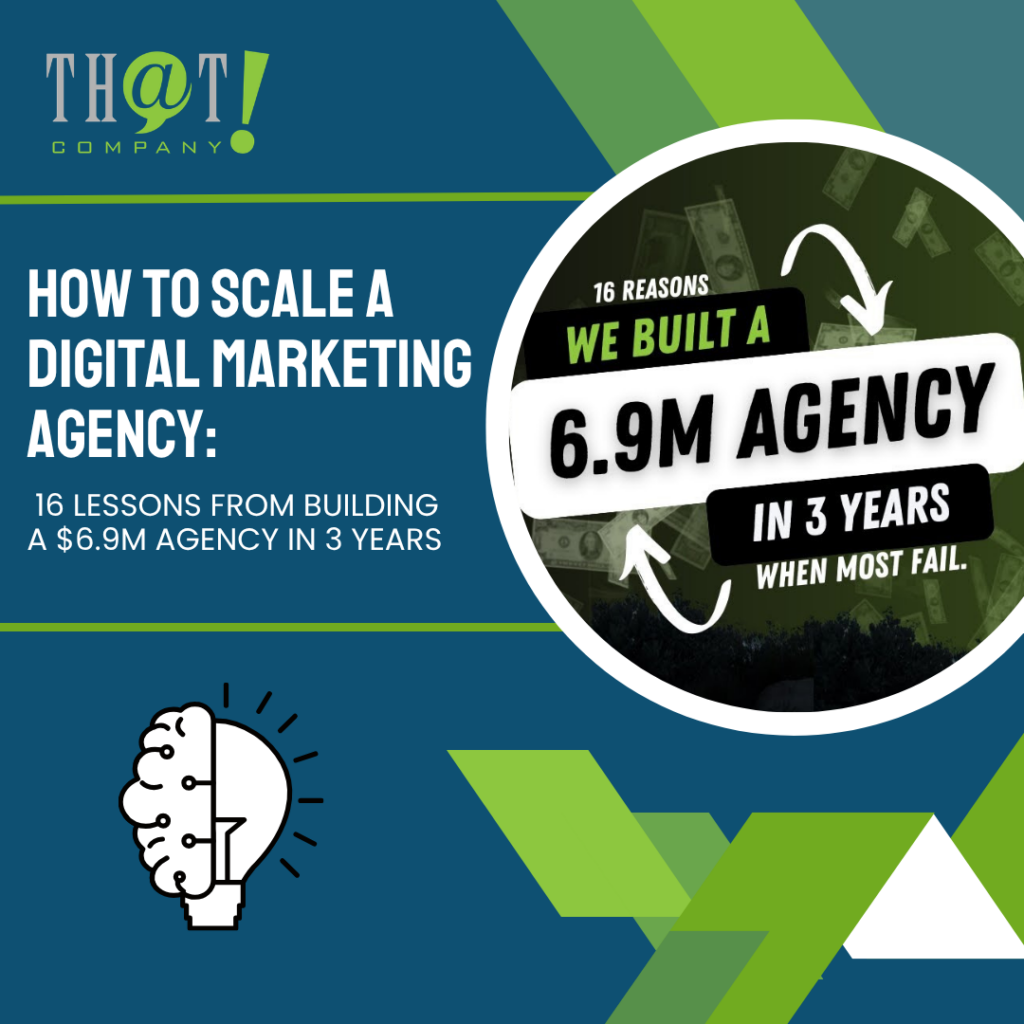
If you are trying to figure out how to scale a digital marketing agency, the lessons in this Mastermind Speaker Series session are less about flashy growth hacks and more about the habits that make growth sustainable. From knowing your numbers to creating a scalable lead pipeline, the discussion breaks down 16 reasons That! Company was able to grow rapidly in its early years and remain in business long after many agencies disappear.
Prefer to hear the stories directly? Watch the full session below. Otherwise, here are the lessons agency owners can apply to their own businesses.
1. Build Your Business Around A Foundation You Believe In
For That! Company, faith was part of the foundation from the beginning.
The company’s leadership regularly referenced the Prayer of Jabez and its request to “enlarge my territory” as a reminder of the larger purpose behind the organization. The lesson extends beyond any single belief system: sustainable businesses tend to have a foundation that helps leadership stay grounded when circumstances become difficult.
Growth brings pressure. Hiring brings responsibility. Losing clients can force uncomfortable decisions.
Knowing what you stand for before those moments arrive can make those decisions clearer.
2. Know Your Numbers
One of the strongest messages from the session is also one of the simplest:
You have to know your numbers.
Revenue alone does not tell you whether the business is healthy. Agency owners should understand what is happening throughout the organization, including:
- Revenue and expenses
- Profitability
- Client churn
- Department performance
- Sales close rates
- Lead volume
- Employee or account-level performance
- Capacity and staffing requirements
As the session puts it, you cannot “deposit hope into your bank account.”
Optimism matters, but optimism is not a financial strategy.

3. Make Decisions Based On The Numbers
Knowing the numbers only helps when you are willing to act on them.
Early in That! Company’s history, the numbers showed that the business could not continue carrying the salary of one of its sales professionals. Letting that person go was difficult, but keeping the expense without the revenue to support it could have put the entire company at risk.
The story has an important ending: the salesperson later returned and became an important part of the company’s growth.
Agency leadership sometimes requires decisions that feel uncomfortable in the moment but protect the organization over the long term.
That becomes especially important when a large client disappears. If an agency hires heavily to support one account and that revenue suddenly leaves, pretending nothing has changed does not protect the team. It simply delays the financial consequences.
The numbers tell you what is happening. Leadership means responding to what they tell you.
4. Do Not Build Your Agency Alone
Growing an agency becomes much harder when every important idea comes from one person.
That! Company began with four people, and the value of having multiple perspectives became part of the culture.
More importantly, those perspectives were allowed to disagree.
Team members should be able to respectfully tell leadership:
- “I think this is the wrong direction.”
- “I see a problem with this plan.”
- “There may be a better way to do this.”
An agency filled with people who agree with the owner all the time is not necessarily aligned. It may simply be an echo chamber.
Healthy disagreement sharpens ideas.
It also creates buy-in because people understand why decisions are being made instead of simply being told what to do.
5. If You Want To Be Big, Start Behaving Like It
There is a difference between wanting a larger agency and building the infrastructure required to operate one.
That means treating the business seriously before it feels “big.”
One example from the session is contracts. Small businesses sometimes rely heavily on handshakes and informal agreements. But as the agency grows, unclear agreements create unnecessary risk.
Professional processes matter.
So do boundaries.
That! Company also made an early decision not to spend excessive time renegotiating standard agreements for relatively small engagements. The administrative and legal effort simply did not justify the value of the deal.
Scaling requires recognizing that every opportunity cannot receive unlimited time and customization.
Build A Company That Is Bigger Than The Founder
This same principle applies to branding.
Agency owners can easily become the entire identity of their company. Clients call the founder. The founder joins every meeting. The founder handles strategy. The founder solves every problem.
That may work initially.
Eventually, it becomes a bottleneck.
It can also make the agency harder to sell because customers are loyal to an individual rather than the organization.
A scalable agency builds trust in the company, its systems, and its team—not only in its founder.
6. Sometimes You Have To Say Yes And Figure It Out
One of the more entertaining stories from the session explains how That! Company entered PPC.
The agency originally focused on web development and SEO. Then an SEO client asked whether the team could manage PPC.
The answer was essentially, “Yes, absolutely.”
After the call came the question:
“What’s PPC?”
That moment led to the creation of an entirely new service line.
The point is not to sell work you cannot competently deliver. It is to recognize when your existing skills give you enough confidence to pursue an opportunity and learn what is necessary to execute it well.
The same pattern eventually helped That! Company enter white-label marketing.
An agency asked whether the team could deliver PPC services under another company’s brand. White labeling was not yet the established service category it is today.
Again, the answer was yes.
Within roughly a year, that agency had around 80 client accounts being serviced through the relationship.
Sometimes an opportunity becomes a business model because someone was willing to explore it.
7. Be Ready To Pivot
Your first version of the business is probably not your final version.
That! Company initially sold websites for a few hundred dollars each. It became clear that one-time website revenue would not create the kind of recurring cash flow needed to build the business they wanted.
So the company moved more heavily into ongoing marketing services and retainers.
That willingness to change direction matters.
Agency owners often become emotionally attached to the original plan simply because it was their plan.
But the market does not care how attached we are to an idea.
The better mindset is to assume that some ideas will be wrong, test them intelligently, and adjust quickly.
Cash Flow Gives You Room To Experiment
Recurring cash flow creates another important advantage: the ability to be wrong without destroying the business.
A healthy core operation can fund experiments.
Some will succeed.
Many will not.
That is part of innovation.
The goal is not to eliminate failure. It is to build a company resilient enough to learn from it.

8. Be Honest, But Think Creatively
When That! Company was still a four-person agency, the team found itself pursuing a major opportunity with DriveTime.
Then came a familiar question:
“How big are you guys?”
Saying “four people” would have been accurate, but it would not have communicated the company’s ambition particularly well.
Instead, the answer highlighted that the company occupied a 4,000-square-foot facility and was looking to expand.
Also true.
The lesson is not to mislead prospects. It is to communicate honestly while presenting your organization in the strongest accurate light.
Small agencies often undersell themselves because they assume size is the only credibility signal that matters.
It is not.
Expertise, responsiveness, strategy, capacity, processes, and results can all matter more than headcount.
9. Look For Opportunities Everywhere
Opportunities rarely arrive wearing a name tag that says “major turning point.”
When That! Company first began exploring PPC tools, the team attempted to purchase software from PPCManagement.com.
The owner refunded the purchase because the software was being discontinued.
That could have ended the conversation.
Instead, the team asked another question:
What are you doing with the domain?
That eventually led to the acquisition of PPCManagement.com, which the company ranked for valuable PPC-related searches. The domain helped generate clients and contributed to opportunities that influenced the company’s future white-label model.
A similar approach later resulted in the acquisition of SEOCompany.com.
The broader lesson is to stay curious.
The opportunity in front of you may not be the one you originally went looking for.
10. Identify Your Marketing Superpower
If you want to understand how to scale a digital marketing agency, figuring out how you consistently acquire customers belongs near the top of the list.
Every agency needs a reliable engine for growth.
For That! Company, that engine has historically been SEO.
Other agency owners may excel at:
- Paid advertising
- Content creation
- Podcasting
- Video
- Strategic partnerships
- Email marketing
- Events
- Outbound sales
The channel itself matters less than discovering something you can repeat and scale.
A growth strategy that only works when the founder personally spends every waking hour doing it is difficult to scale.
Delegate What Pulls You Away From Your Strength
Once you discover what you do exceptionally well, protect the time required to keep doing it.
That means delegating other responsibilities as soon as it makes financial and operational sense.
Agency owners often become trapped doing fulfillment, administration, troubleshooting, account management, sales, and marketing simultaneously.
Eventually, something suffers.
Frequently, it is the very activity that generates new business.
11. Focus Relentlessly On Lead Pipeline And Sales
Agency owners can spend an extraordinary amount of time improving things that are not currently limiting growth.
The session describes this as “rearranging the chairs on the Titanic.”
For example, an agency owner might repeatedly redesign a website because five people visited and none converted.
The bigger problem is not necessarily the conversion rate.
It may be that only five people visited.
Optimization matters, but it cannot replace demand generation.
A scalable agency needs enough qualified prospects entering the pipeline to create consistent sales opportunities.
That means agency leadership should regularly be asking:
- How many qualified leads are we generating?
- Where are they coming from?
- How many become sales conversations?
- How many proposals are we creating?
- What percentage are closing?
- Which acquisition channels are scalable?
A beautiful agency does not grow because it is beautiful.
It grows because the right people consistently discover it, trust it, and buy from it.
12. Define Your Values And Build Your Tribe
Company culture does not have to be complicated.
One of That! Company’s long-standing values has been simple: have fun in the process.
Over the years, that showed up through arcade games, foosball, company competitions, recognition programs, anniversary traditions, and—perhaps most memorably—leadership calling employees simply to tell elaborate dad jokes.
None of those things alone creates a culture.
Together, however, they communicate something about what the organization values.
As workplaces evolve, especially with remote teams, the tactics may need to change. The values do not.
When leadership consistently demonstrates its values, the people who identify with those values are more likely to stay, contribute, and help reinforce them.
13. Leverage What You Have
The “$6.9 million agency” figure discussed in the session comes with an important piece of context.
Roughly $3 million of that revenue consisted of Google Ads spend from one large client flowing through the business. Operational revenue was closer to $3.9 million.
Rather than hide that distinction, the session highlights it openly.
But the company also recognized that the overall revenue figure created a legitimate opportunity.
That growth contributed to That! Company’s placement at No. 183 on the Inc. 500 list of fastest-growing privately held companies in 2011.
That recognition created social proof, which helped generate additional opportunities.
The lesson is simple:
When you earn a meaningful achievement, use it.
Awards, milestones, partnerships, years in business, client results, specialized expertise, certifications, and media recognition can all strengthen credibility.
Do not manufacture authority.
But do not hide genuine authority either.

14. Invest In Coaching
You do not know what you do not know.
That is one reason That! Company’s leadership has invested in executive coaching, sales training, and operating frameworks such as EOS.
Good coaching creates space to think.
It can also introduce an outside perspective capable of asking questions your internal team may not think to ask.
Coaching can help leaders:
- Challenge assumptions
- Evaluate new opportunities
- Avoid predictable mistakes
- Improve accountability
- Strengthen sales processes
- Run better meetings
- Clarify priorities
Mastermind groups can serve a similar purpose by exposing agency owners to how other leaders solve problems.
The point is not that someone else should run your business for you.
It is that you should not have to learn every lesson through your own expensive mistake.
15. Protect Your Name By Serving Clients Well
Revenue matters.
But there is something more durable than the revenue from any individual account: your reputation.
The session emphasizes focusing on the customer and the outcome rather than simply chasing money.
A weak product supported by strong sales can grow temporarily.
Eventually, reality catches up.
Strong companies deliver something genuinely worth buying.
That also requires enjoying the work enough to remain committed when the industry changes—and digital marketing changes constantly.
Algorithms shift.
Platforms evolve.
Client expectations change.
New competitors appear.
Technology moves quickly.
Agency owners who see every change as an inconvenience may eventually burn out. Owners who view the next challenge as another problem worth solving are better equipped for the industry.
Your company name and your personal name follow you.
Treat both like long-term assets.
16. Underpromise And Overdeliver
The final lesson connects many of the others.
Set expectations you genuinely believe you can meet.
That! Company has historically been cautious about guaranteeing marketing outcomes because every client, market, competitive environment, and campaign is different.
Experienced marketers can recommend a strategy based on the available data.
Execution still determines what happens next.
There is a major difference between confidence and unrealistic promises.
Strong agency relationships are built when the deliverable consistently meets or exceeds what the client expected.
That does not require perfection. Every long-running agency loses clients.
What matters is building expectations around what you reasonably believe your team can accomplish and then working to outperform them.
How To Scale A Digital Marketing Agency Without Becoming The Bottleneck
Across all 16 lessons, one theme keeps resurfacing:
A scalable agency cannot depend on the owner doing everything.
The owner needs room to lead, build relationships, improve the sales pipeline, identify opportunities, and apply their strongest skills.
That is difficult when every campaign, report, strategy call, and client question eventually lands on the founder’s desk.
Delegation is therefore not simply about saving time.
It is about creating capacity for growth.
For some agencies, that means hiring internally. For others, it means building a trusted fulfillment partnership.
A strong white-label relationship can allow an agency to continue selling services under its own brand without building every fulfillment department from scratch.
At That! Company, our approach to White Label Digital Marketing goes further than simply completing campaign work behind the scenes. We can support agencies during the sales process and communicate directly with their clients under the agency’s brand, helping owners spend more time working on the agency instead of constantly working in it.
Key Takeaways For Agency Owners
Building a durable agency is rarely the result of one breakthrough.
It is the result of many disciplined decisions made repeatedly.
The 16 lessons from this session can be condensed into a few core principles:
- Know the numbers and act on them.
- Surround yourself with people willing to challenge your thinking.
- Build systems that do not depend entirely on the founder.
- Say yes to promising opportunities when you have the ability to figure them out responsibly.
- Expect to pivot and keep testing.
- Find a scalable method for generating leads.
- Protect your time by delegating work outside your strongest skill set.
- Invest in relationships, culture, coaching, and continuous improvement.
- Treat your reputation as a long-term asset.
- Set realistic expectations and work hard to exceed them.
There is no formula that guarantees an agency will reach a particular revenue number.
But there are habits that make sustainable growth far more likely. Build around those habits, keep your eyes open for opportunities, and create an organization that can keep growing even when you are no longer the person doing everything.