Skip to content

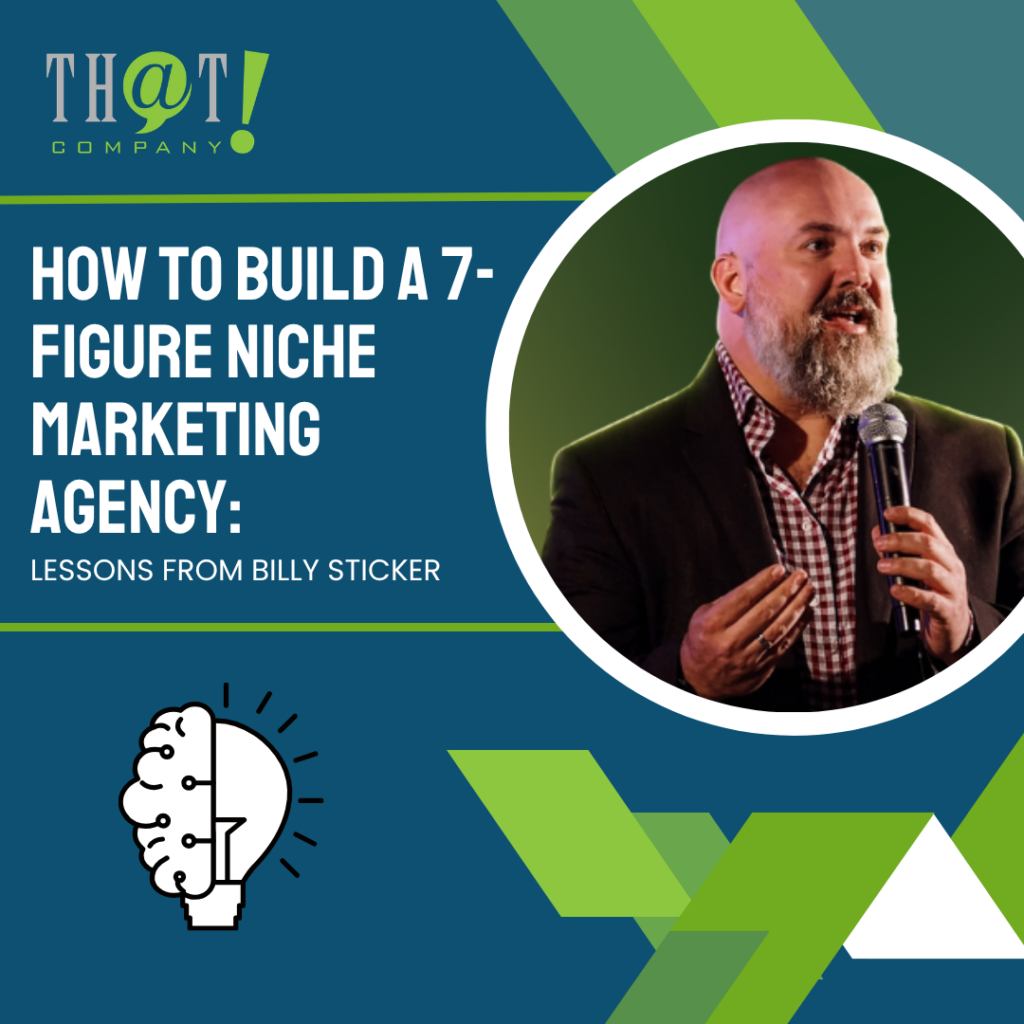
Building a 7-figure niche marketing agency rarely comes down to one breakthrough tactic. More often, it is the result of choosing the right market, building trust consistently, creating a strong referral engine, and developing systems that allow the agency to grow without depending on the founder for every decision.
That is exactly what Billy Sticker did with ChiroCandy, a marketing agency focused on the chiropractic industry. At its peak, the agency served roughly 350 active accounts and averaged about 20 new accounts per month for several years.
Billy’s story is especially useful for agency owners because he did not begin with a formal plan to build an agency. He started by sharing useful ideas with a very specific audience. The authority, relationships, referrals, and service opportunities followed.
For those who prefer to watch the full conversation, the video below covers Billy’s journey in detail. Below, we break down the most practical lessons agency owners can apply to their own businesses.
Start With a Niche You Can Understand Deeply
Before ChiroCandy became an agency, Billy worked inside chiropractic offices as a marketer. He learned how the profession operated, understood the language chiropractors used, and saw firsthand what practice owners needed.
That experience gave him an advantage that many generalist agencies never develop: market fluency.
He was not simply selling Facebook ads to chiropractors. He understood patient volume, practice growth, high-value treatments, common operational challenges, and the economic realities of the profession.
That depth matters.
A niche marketing agency becomes more valuable when it can do more than execute campaigns. It should understand:
- How the client makes money
- What a qualified lead is worth
- Which services create the highest lifetime value
- What operational problems can limit marketing performance
- Which industry relationships influence buying decisions
- What language resonates with the client’s audience
Billy’s early success came partly from recognizing that chiropractors had a valuable customer base and strong professional networks. Many attended the same coaching programs, graduated from the same schools, joined the same associations, and regularly exchanged referrals.
That made the market especially well suited for relationship-based growth.
Use Content to Build Authority Before You Sell
Billy launched the ChiroCandy podcast in 2015 as a marketing resource for chiropractors. He interviewed influential people in the profession and published episodes consistently.
The podcast was not originally designed as a lead-generation funnel for an agency. In fact, the agency did not fully exist yet.
But the podcast accomplished something more valuable than a traditional sales pitch: it made Billy familiar.
Week after week, chiropractors heard his ideas, learned from his guests, and became comfortable with his perspective. Over time, that familiarity turned into trust.
As Billy explained during the session, a podcast gives agency owners an opportunity to get in front of influential people who might never agree to a general networking call. Asking someone to “pick their brain” is easy to ignore. Inviting that same person to be featured as an expert is a much more attractive proposition.
The result is a relationship-building platform that can help an agency:
- Connect with industry leaders
- Build credibility in a defined market
- Create long-form educational content
- Generate clips, articles, emails, and social posts
- Stay visible with prospective clients
- Develop referral partnerships
Billy’s podcast eventually helped position him as a recognizable authority within chiropractic marketing. He began speaking at industry events and building relationships with association leaders and other influential professionals.
The lesson is not that every agency must start a podcast. The lesson is that consistent, niche-specific content can create an authority advantage that paid advertising alone cannot replicate.

Build a “Referral 100,” Not Just a Prospect List
Many agencies build a list of 100 companies they want as clients.
Billy recommends a different approach: build a list of 100 people who could refer clients.
This distinction can dramatically change an agency’s growth strategy.
One prospect may become one client. A strong referral partner may introduce five, 10, or 20 clients over time.
Billy used his podcast to connect with coaches, consultants, association leaders, vendors, and other people who already had relationships with chiropractors. Those relationships gave ChiroCandy access to established trust networks.
For agency owners, potential referral sources may include:
- Business coaches
- Industry consultants
- Software providers
- Trade associations
- Website developers
- Fractional executives
- Accountants and attorneys
- Sales trainers
- Event organizers
- Influential content creators
The key is to think beyond immediate buyers.
Ask: Who already has the attention and trust of the people we want to serve?
Those are often the relationships worth investing in first.
Turn Client Referrals Into a Repeatable Growth System
ChiroCandy’s referral program was one of the most memorable parts of Billy’s growth model.
The offer was simple: refer three active chiropractic clients, and ChiroCandy would manage the referring client’s marketing for free as long as those three referrals remained active.
At first glance, that may sound expensive. In practice, it worked because relatively few clients reached the three-referral threshold.
Even when the agency had approximately 350 active accounts, Billy said only about 12 clients were receiving free services.
Most clients referred one or two people. A smaller number referred many more.
That meant the program created a steady stream of new business without giving away an unsustainable amount of work.
Why the Referral Program Worked
The offer had several advantages:
- The reward was easy to understand.
Clients knew exactly what they had to do and what they would receive.
- The incentive was valuable.
Free marketing had a clear financial benefit.
- The reward depended on active referrals.
The program encouraged clients to make quality introductions, not random ones.
- The niche was highly connected.
Chiropractors often knew dozens of other practice owners.
- The economics were modeled before launch.
Billy calculated whether the program would remain profitable at scale.
Agency owners do not need to copy the structure exactly. Depending on margins, pricing, and fulfillment costs, a referral program could offer:
- A monthly service credit
- A percentage of recurring revenue
- A one-time referral bonus
- A free add-on service
- A reduced retainer
- A limited period of free service
The important part is to design the program around unit economics rather than enthusiasm.
A referral offer should be compelling enough to motivate action without creating a delivery burden the agency cannot support.
Prove the Offer Before Scaling It
Billy’s first Facebook advertising client came from a conversation with a chiropractor who had struggled to make the channel work.
Billy offered to run the campaign for a month at no management cost. The campaign generated approximately 60 leads, which was highly valuable in a market where a single neuropathy case could be worth thousands of dollars.
That success created proof.
The client referred other chiropractors. Those clients referred more. ChiroCandy began growing through a combination of results, referrals, and eventually paid advertising.
Billy later described this process using what he calls the Five Ps:
1. Problem
Identify the specific business problem you are going to solve.
For ChiroCandy, the initial problem was patient lead generation.
2. Product
Choose the service or solution that will address the problem.
In the early days, that product was Facebook advertising.
3. Plan
Develop a repeatable process for delivering the service.
The work must become systematic enough that another team member can eventually follow it.
4. Proof
Create case studies that demonstrate the plan works.
Proof reduces perceived risk and gives the sales team something concrete to discuss.
5. Promotion
Use the case study to promote the offer through content, partnerships, referrals, outbound sales, or paid media.
This framework is especially helpful for new niche agencies. It keeps the agency from trying to scale an offer before the positioning, delivery process, and proof are strong enough.

Choose Clients Who Are Prepared to Succeed
One of Billy’s strongest warnings was that agencies should not try to save failing businesses through marketing.
A company may desperately need more leads, but that does not automatically make it a good client.
If the business cannot answer calls, convert leads, retain customers, manage cash flow, or deliver a good customer experience, more marketing may simply create more visible problems.
Billy shared the example of a chiropractor who had been practicing for more than 20 years but was seeing only about 50 patients per week across two offices. That level of performance suggested deeper operational issues.
The problem was not simply a lack of leads.
Instead of selling marketing services, Billy recommended business coaching resources that could address the underlying issues.
That decision reflects a healthy sales philosophy: qualify for fit, not just willingness to pay.
Red Flags to Watch During the Sales Process
A prospective client may be a poor fit when:
- Payroll and basic expenses are already difficult to cover
- The owner expects immediate, guaranteed results
- The business lacks a clear sales or intake process
- The team cannot respond to leads quickly
- The owner has unrealistic expectations about cost
- The business has a long history of underperformance
- The prospect blames every previous provider
- The client would create an outsized support burden
Billy’s team reinforced this standard by tying sales compensation to client quality. If a salesperson knowingly signed a poor-fit client who churned quickly, the commission could be clawed back.
That creates an important alignment: the sales team is rewarded for bringing in durable clients, not simply closing deals.
Client Retention Requires Visible Care
Results matter, but results alone are not always enough to retain clients.
Clients also need to see that the agency is paying attention.
Billy encourages his team to communicate the work they are doing, even when a formal update is not required. A small optimization may be routine to the agency, but telling the client about it reinforces the value of the relationship.
ChiroCandy used several simple retention practices:
- Weekly performance emails
- Short Loom videos every other week
- Easy access to account representatives
- Proactive outreach from the founder
- Welcome boxes for new clients
- Clear communication about changes and next steps
The Loom videos were intentionally brief, typically between 60 and 90 seconds. They answered four practical questions:
- What is working?
- What is not working?
- What did the team change?
- What should the client expect next?
This format respects the client’s time while still creating a consistent record of communication.
It also prevents the familiar agency problem where a client says, “I have not heard from anyone,” even though work has been happening behind the scenes.
Silence creates uncertainty. Clear, consistent communication creates confidence.
Make the Onboarding Experience Memorable
Every new ChiroCandy client received a welcome box with branded merchandise, books, and useful items.
The gift was not promoted during the sales process. It arrived as a surprise.
That small gesture gave clients an immediate reason to feel positive about the relationship. It also made the agency feel established, thoughtful, and attentive.
A welcome package does not need to be elaborate. The purpose is to reinforce the client’s decision and create a human connection early in the relationship.
Agencies might include:
- A handwritten note
- A small branded gift
- A printed onboarding guide
- A book related to the client’s goals
- A launch checklist
- A team introduction card
- A useful desk item
The first few days of a client relationship are often filled with forms, access requests, meetings, and technical details. A thoughtful gesture can make the experience feel less transactional.
Add Stickier Services to Improve Retention
ChiroCandy initially grew through Facebook advertising. That service created demand, but paid advertising can also produce higher churn because clients watch lead volume and cost closely.
Billy said he would have expanded into stickier services sooner.
Services such as SEO, website development, and broader omnichannel marketing can become more deeply integrated into the client’s business. They often require a longer time horizon and are less likely to be judged by one difficult week.
This does not mean agencies should abandon paid media. It means the strongest client relationships often involve a balanced mix of services.
For example, a client may use:
- Paid social for demand generation
- Google Ads for high-intent traffic
- SEO for long-term visibility
- Website optimization for conversion
- Social media for brand trust
- Reporting and strategy for coordination
When multiple channels work together, the client sees the agency as a growth partner rather than a single-channel vendor.
Build the Team Around the Culture
Billy did not begin by hiring experienced agency professionals.
He often hired people he already knew, trusted, or shared values with. Many started part-time and learned the systems gradually.
That approach allowed ChiroCandy to develop people inside the company culture rather than relying entirely on outside experience.
Account managers eventually handled approximately 25 to 30 accounts each. They managed client communication, campaign setup, creative decisions, optimization, and reporting.
Some account managers later transitioned into sales because they already understood the service and could answer detailed prospect questions.
This is a practical lesson for agencies struggling to recruit experienced talent.
Sometimes the best hire is not the person with the longest resume. It is the person with the right values, learning ability, communication skills, and sense of ownership.
Processes can be taught. Reliability and character are harder to install.

Use White Label Fulfillment to Focus on Growth
When asked what he would do if he had to start again with no audience, niche, or client list, Billy said he would choose a niche, identify influential referral sources, build authority, and find a reliable white label provider.
The reason was straightforward: he would not want to spend his time doing all the fulfillment himself.
That is a crucial distinction for agency owners.
The activities that grow an agency are not always the same activities that deliver the work. Founders can easily become trapped inside campaign management, reporting, troubleshooting, and production.
A capable white label partner allows the agency owner to focus on:
- Building industry relationships
- Creating authority content
- Developing referral partnerships
- Leading sales conversations
- Improving the client experience
- Expanding into new services
- Strengthening the agency’s positioning
The best white label relationships go beyond task fulfillment. They help the agency close business, communicate with clients under the agency’s brand, and create the operational capacity needed for the owner to work on the agency rather than inside it.
For agencies ready to expand without building every department internally, our White Label Digital Marketing services provide fulfillment, sales support, and client-facing communication under your brand.
The 30-Day Plan for Starting a Niche Marketing Agency
Billy’s advice for starting over can be turned into a simple 30-day framework.
Week 1: Select the Market
Research industries where one new customer has meaningful lifetime value.
Look for markets with:
- Healthy profit margins
- Recurring or high-ticket revenue
- Established professional networks
- Clear marketing problems
- Enough businesses to support growth
Week 2: Define the Offer
Choose one important problem and one focused service that solves it.
Avoid launching with a long list of disconnected services. A clear offer is easier to explain, prove, and sell.
Week 3: Build Proof
Find one or two businesses willing to test the offer.
Use a pilot, reduced fee, or carefully structured trial to create measurable outcomes. Document the starting point, the work performed, and the result.
Week 4: Build Relationships and Promote
Create a list of referral sources and industry influencers.
Invite them to a podcast, webinar, interview series, roundtable, or other collaborative platform. Share the proof you created and begin building a reputation inside the niche.
The goal is not to look like the largest agency in the market.
The goal is to become useful, credible, and known.
Key Takeaways for Agency Owners
Billy Sticker’s story shows that a 7-figure niche marketing agency can be built through consistent steps rather than dramatic leaps.
The most important lessons are:
- Choose a niche you can understand deeply
- Use content to build familiarity and authority
- Prioritize referral sources, not only direct prospects
- Create a referral program with sustainable economics
- Prove the offer before scaling promotion
- Qualify clients based on their ability to succeed
- Communicate the work, not just the results
- Add services that create deeper, longer relationships
- Hire for culture and develop skills internally
- Use white label fulfillment to protect the founder’s time
The common thread is focus.
Billy focused on one market, one audience, one clear problem, and a relationship-driven growth model. That clarity made the agency easier to position, easier to refer, and easier to scale.
For agency owners who feel pulled in too many directions, that may be the most useful lesson of all: growth often begins by narrowing the field.