Skip to content

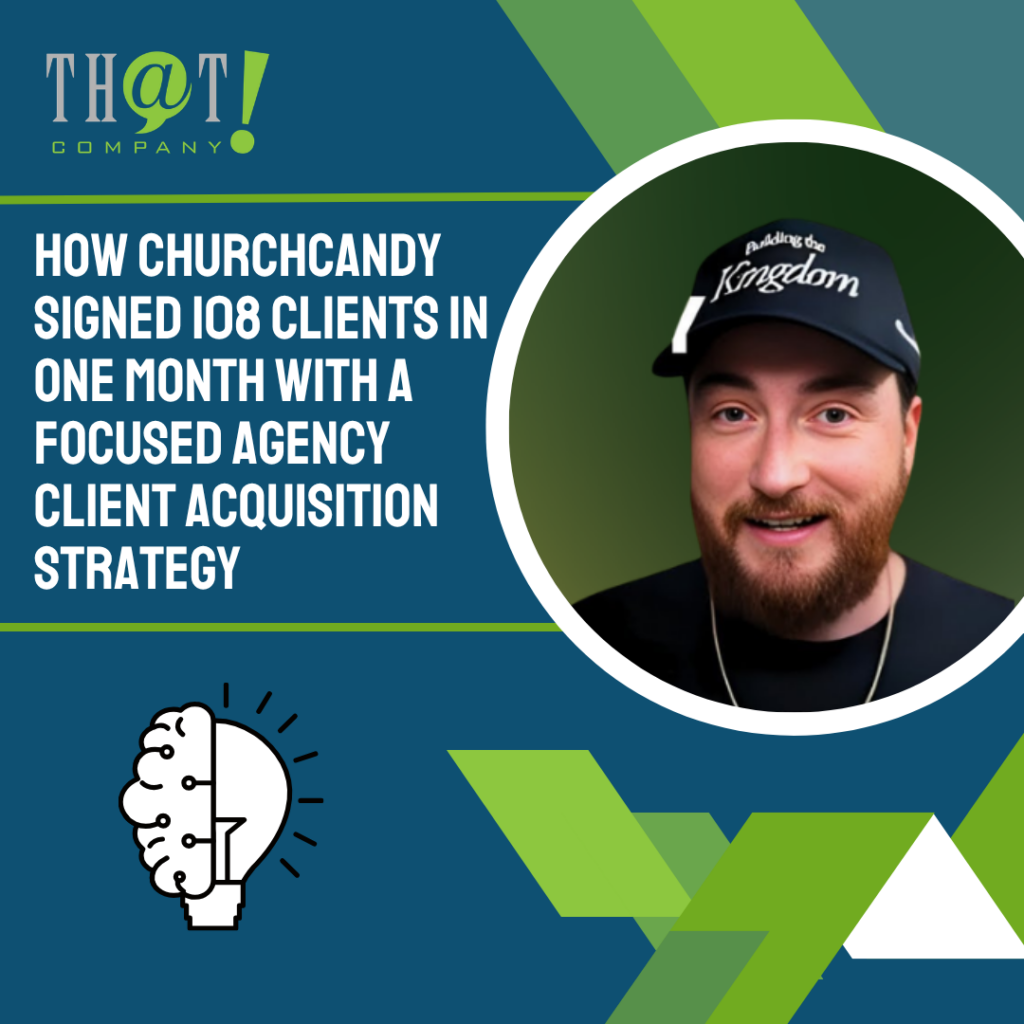
Every agency owner wants more clients. Fewer agency owners build a repeatable system that consistently turns results into proof, proof into marketing, and marketing into new sales conversations.
That is exactly what Brady Sticker and the ChurchCandy team did.
In this Mastermind Speaker Series session, Brady shared how ChurchCandy signed 108 total clients in one month, including the simple but powerful growth loop behind it: get clients, get them results, document the results, and use that documentation to win the next client. For agency owners looking for a practical agency client acquisition strategy, this conversation is packed with lessons worth applying.
The Growth Loop Behind ChurchCandy’s Client Acquisition Strategy
ChurchCandy’s growth was not built on chasing every new marketing trend. It was built on focus.
Brady explained that their core process was simple:
- Get a new client.
- Work hard to get that client strong results.
- Document those results through testimonials, podcast interviews, and client stories.
- Use that proof in marketing to attract the next client.
- Repeat the cycle.
That loop became the engine behind ChurchCandy’s growth.
Instead of constantly reinventing their offer, their funnel, or their niche, ChurchCandy leaned into what was already working. Their team used client success stories as the foundation for ads, email nurturing, and reactivation campaigns.
That is a lesson many agencies overlook. The best marketing asset is often not a clever headline or a fancy funnel. It is a real client saying, “This worked for us.”
Why Focus Beat Shiny Object Syndrome
Brady’s number one piece of advice for new or struggling agency owners was direct: stay focused.
He warned that agency owners often move away from what is working too soon. If Facebook ads are producing clients, do not immediately jump to TikTok ads. Do more Facebook ads. Then do them better. Only after that should you consider adding something new.
As Brady put it, agency owners need to “squeeze all the juice” out of a working channel before chasing another one.
That advice matters because growth often feels boring when it is working. The temptation is to assume the next strategy will be more exciting, more scalable, or more impressive.
But ChurchCandy’s story shows that scale often comes from disciplined repetition.
From Failed Ads To A Repeatable Offer
ChurchCandy did not start with instant success.
Brady shared that one of his earliest campaigns for his own church spent $500 promoting an event, and no one showed up. That could have been the end of the story. Instead, his pastor gave him room to keep testing.
Over time, Brady refined the offer, the messaging, and the follow-up until Facebook and Instagram ads began producing real results for churches.
That early failure became an important part of the journey. It gave ChurchCandy the testing ground needed to understand the niche, build confidence, and eventually create a service churches wanted to buy.
The lesson for agencies is clear: failed campaigns are not always wasted campaigns. Sometimes they are the tuition you pay to build the system that works.
How ChurchCandy Turned A Course Failure Into An Agency
Before ChurchCandy became a full-service agency, Brady tried selling a course.
He hosted a webinar for pastors and sold a $500 training program that taught churches how to run their own ads. He sold a handful of courses and was excited about the momentum.
Then he checked in.
Most buyers had not even logged in.
That could have been discouraging, but it revealed something important: the churches wanted the outcome, but they did not want to do the implementation themselves.
Several asked, “Can we just pay you to do it for us?”
That was the opening for ChurchCandy’s agency model.
For agency owners, this is a useful reminder: when prospects do not use your DIY product, it may not mean they do not value the solution. It may mean they value the outcome enough to pay someone else to handle it.

The Power Of A Simple, Niche-Specific Offer
ChurchCandy’s offer was not complicated.
They helped churches get new guests using Facebook and Instagram ads. Their service included the ad campaign and a white-labeled Go High Level sub-account for follow-up.
The simplicity mattered.
Because ChurchCandy served one niche with one primary offer, the team could systemize fulfillment. They were not rebuilding a custom strategy from scratch for every client. They could personalize the creative and messaging while keeping the operational structure consistent.
That kind of focus creates leverage.
For agencies, this is where niche specialization can become a real advantage. When your offer is narrow enough, your team can improve delivery, sales conversations become clearer, and your proof becomes more persuasive.
How Testimonials Became ChurchCandy’s Best Ads
One of the biggest takeaways from the session was how intentionally ChurchCandy documents client success.
When a church gets strong results, Brady’s assistant reaches out to request a testimonial video. In some cases, ChurchCandy flies clients to Houston to appear on their podcast.
Those podcast clips then become ad creative.
Brady explained that in-person podcast-style testimonials often outperform standard Zoom testimonials because they feel more organic and familiar in the social feed. They look like content people are already used to consuming, which makes them easier to watch and trust.
The strategy works because it does not rely on ChurchCandy simply telling prospects, “We can help you.” It lets successful clients show what happened.
That is especially powerful for agency marketing. Your prospects may be skeptical of your pitch, but they are far more likely to trust someone who looks like them, serves the same type of customer, and has already experienced the result they want.
Why Timing Helped ChurchCandy Sign 108 Clients
The 108-client month was not only about ads. Timing played a major role.
For churches, the weeks leading up to Easter are a high-priority season. ChurchCandy already had prospects who had engaged with their funnel, watched their content, or considered signing up.
The team made a timely offer: sign up before Easter and receive 50% off the first month.
That offer worked because it was attached to a real business need. Churches wanted more guests for Easter. ChurchCandy’s service directly supported that goal.
The discount was not the whole strategy. It was the final nudge for prospects who already understood the value.
This is an important distinction for agencies. Discounts alone rarely create strong demand. But when you combine a clear offer, a warm audience, a timely deadline, and a relevant business outcome, the offer becomes much more compelling.
Reactivation Was A Major Part Of The Win
ChurchCandy did not rely only on brand-new leads.
A major part of the campaign came from reactivating people who were already in their world. The team sent direct messages and texts to pastors who had previously engaged, asking whether they wanted new guests in time for Easter.
That message worked because it was specific, timely, and outcome-driven.
It did not say, “Do you want marketing services?”
It said, in effect, “Do you want more of the thing you care about before a major event on your calendar?”
That is the difference between selling services and selling outcomes.
Agencies can apply the same idea by looking at their own dormant leads, old proposals, past clients, webinar attendees, and email subscribers. Many of them may not be “dead leads.” They may simply be waiting for the right moment and the right reason to act.
What White Label Agencies Can Learn From ChurchCandy
One audience member asked whether agencies using a white-label partner should still run ads for their own agency.
Brady’s answer was yes.
In fact, he argued that white-label agencies may have even more reason to run ads because they are not buried in fulfillment. If delivery is handled by a trusted partner, the agency owner can spend more time on sales, marketing, relationship building, and growth.
That aligns closely with how we think about agency scale at That! Company.
A strong white label partner should give agency owners more room to work on the business instead of being trapped inside daily fulfillment. When fulfillment, client communication, and campaign execution are handled under your brand, you can focus on the growth activities that move the agency forward.
For agencies that want to scale without adding more operational complexity, White Label Digital Marketing can create the space needed to build a stronger client acquisition engine.
The Biggest Takeaway: Results Create The Next Sale
ChurchCandy’s 108-client month was impressive, but the more important lesson is the system underneath it.
They did not scale because of one magic campaign. They scaled because they built a machine around proof.
Get results. Capture the story. Put the story in front of the right prospects. Follow up. Make a timely offer. Repeat.
That is a practical agency client acquisition strategy any agency can learn from, even if the niche, offer, or channel is different.
Key Takeaways For Agency Owners
ChurchCandy’s story gives agency owners several clear lessons:
- Stay focused on what is already working before chasing new channels.
- Use client results as the foundation of your marketing.
- Turn testimonials into ads, emails, and sales assets.
- Build a simple offer that is easy to explain and deliver.
- Reactivate warm leads when timing creates urgency.
- Create space for growth by getting support with fulfillment and delivery.
The punchline is refreshingly simple: sustainable agency growth is not always about doing more things. Sometimes it is about doing the right thing, better and more consistently than everyone else.