Skip to content

Cold outreach can work. It can also consume an enormous amount of time, energy, and follow-up for a relatively small number of wins.
In this Mastermind Speaker Series session, the conversation explores a different approach to agency lead generation: instead of spending all your prospecting effort on individual businesses that may become one client, build relationships with people and organizations that can introduce you to many qualified prospects at once. That approach is framed as the COI model, or Center of Influence model.
If you prefer to watch the full discussion, the video below covers the complete session. Below, we break down the core ideas, where the model may fit, and how an agency owner can start thinking about it practically.
Why Traditional Agency Lead Generation Can Be So Expensive
The session begins with a familiar agency growth problem: cold calling can produce business, but the math is often demanding.
The speaker shares historical results from running a cold-calling team between 2013 and 2015. In that experience, it could take roughly 50 to 100 calls to generate one appointment, no-show rates were high, and the close rate was around 6%.
That did not mean cold calling was unprofitable. In fact, one client acquired through that effort grew into a very valuable long-term account. The larger point was that cold outreach becomes far more attractive when the potential value of each successful relationship is high enough to justify the acquisition effort.
For agency owners, that creates an important question:
If your time and attention are limited, are you better off pursuing one prospect at a time—or building relationships with people who can introduce you to many prospects?
That question is the foundation of the COI model.
What Is a Center of Influence?
A Center of Influence, or COI, is a person, company, association, supplier, advisor, or other organization that already has trusted relationships with the type of clients you want to reach.
The session describes several possible COI structures.
The Affiliate Model
A COI makes introductions in exchange for compensation.
This can be straightforward and scalable, but it also consumes margin and can make the relationship feel more transactional.
The Give-and-Take Model
Two parties exchange referrals without money changing hands.
This can work well, especially in networking groups and local business communities, but it can also be inconsistent. One party may refer frequently while the other has fewer opportunities to return the favor.
The Mutualism Model
The main focus of the session is what the speaker calls the COI mutualism model.
Instead of paying for access or relying on a one-for-one referral exchange, the agency gives the COI something valuable that helps the COI serve its own audience better.
In return, the COI provides access to that audience.
The proposed value exchange is simple:
- The agency provides useful education or training.
- The COI offers that training as a value-add to its customers, members, or network.
- The agency gains exposure to multiple qualified prospects in a trusted environment.
- The COI strengthens its own relationship with its audience without having to create the training itself.
The model is relationship-driven rather than purely transactional, which aligns closely with the way we think strong agency partnerships should work: create real value first, make expectations clear, and build trust over time.
The Core Agency Lead Generation Shift: One-to-One vs. One-to-Many
One of the strongest ideas in the session is the shift from one-to-one prospecting to one-to-many authority building.
In a traditional cold outreach model, the flow often looks like this:
- Contact a large number of prospects.
- Book a small percentage into appointments.
- Build value in individual conversations.
- Present a proposal.
- Close a percentage of those opportunities.
The COI model changes the sequence.
Instead of cold calling end clients, you identify organizations that already serve your target market. Then you build a relationship with those organizations and offer to educate their audience through a live event, webinar, workshop, or similar format.
That gives you the opportunity to build trust with many prospects at the same time.
As the speaker puts it, the logical question becomes: why spend the same amount of relationship-building effort on someone who might become one client when you can spend it on someone who could introduce you to many?
How to Identify the Right COIs
The model becomes much easier to execute once your agency is specific about the market it wants to serve.
That does not mean turning away every opportunity outside your niche. It means focusing your proactive marketing effort where you can build repeatable expertise, proof, and relationships.
The session recommends asking questions such as:
- What services does your target market already use?
- What products do they buy?
- What software or tools do they depend on?
- Who do they already trust?
- What industry resources, associations, or publications do they follow?
Those questions help uncover organizations that serve the same audience without directly competing with your agency.
Example: Dentists
If your agency specializes in dental practices, dental supply companies may be natural COIs.
They already have relationships with dentists. They are not necessarily selling marketing services. And they have an incentive to help their customers grow because stronger practices can become stronger long-term buyers.
Example: Roofing Companies
If roofers are your niche, roofing suppliers may already have a concentrated network of the businesses you want to reach.
That is particularly attractive for agencies that can replicate campaigns across local markets without creating conflicts between clients.
Example: Professional Athletes
For agencies serving athletes, financial advisors, family offices, sports organizations, or other trusted professional networks may be more useful COIs than generic prospect lists.
The common thread is not the industry. It is the relationship.
A strong COI already has the audience, trust, and access that your agency is trying to build.

Your COI Pitch Should Start With Their Benefit
A weak COI pitch sounds like:
“Can you introduce me to your customers?”
A stronger pitch sounds more like:
“I can help your customers become more successful, and I can do it in a way that makes your relationship with them more valuable.”
That distinction matters.
The session proposes a local outreach concept centered on helping the COI’s customers grow without charging the COI for the educational experience. The details would naturally need to be adapted to the niche, offer, and economics of the agency, but the underlying principle is useful:
Lead with the value you create for the COI, not the access you want from them.
That makes the conversation easier because the COI is no longer being asked to “give up” its audience. It is being offered something that may improve the customer experience.
Education Is the Engine of the COI Model
The model depends on high-quality education.
A COI is taking a reputational risk when it introduces you to its customers or members. If your workshop feels like a disguised sales pitch, that relationship may end quickly.
The session recommends building presentations that create genuine “write this down” moments.
That means giving attendees:
- Specific actions they can take
- Useful tools or resources
- A clear explanation of why the issue matters
- Practical guidance on how to execute
- Enough substance that they leave knowing something they did not know before
A useful rule from the session is this: if no one is taking notes, the presentation may contain too much sales language and not enough practical value.
That is a useful standard for any agency educational content.
Teach first.
Demonstrate expertise through usefulness.
Then make it easy for the right people to take the next step.
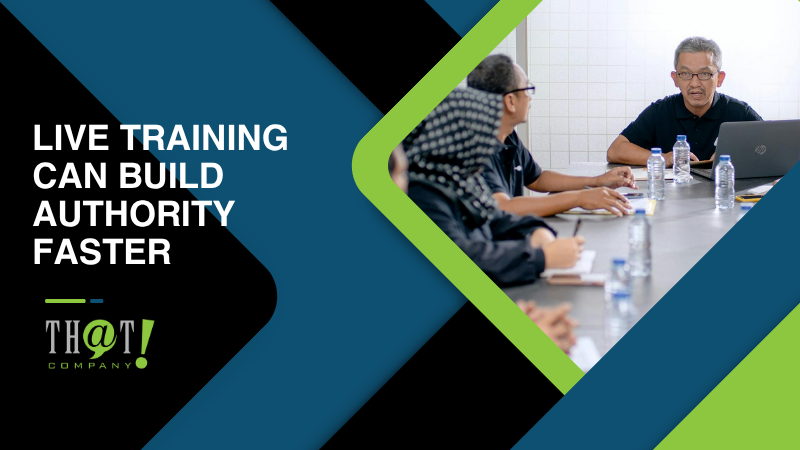
Live Training Can Build Authority Faster
The group discussion also highlights the authority that comes from speaking in front of an audience.
One participant described presenting a training through a builders association. The session generated follow-up calls and ultimately two clients, despite the presentation including no direct sales pitch.
That example reinforces an important point: education itself can be the sales mechanism.
When the audience sees that you understand their business and can explain something valuable clearly, trust can develop before a sales conversation begins.
The session also discusses live webinars, in-person events, recorded training libraries, podcasts, and association involvement as variations on the same broader strategy. Live experiences may create deeper personal connection, while digital formats can be easier to scale.
Associations Can Become Powerful Centers of Influence
Industry associations can function as highly effective COIs because they already aggregate a defined market.
But joining is not enough.
One speaker emphasized that active participation made the difference. Showing up consistently, contributing to events, building relationships with leadership, and becoming a familiar name created far more value than simply paying dues and accessing a member directory.
That is an important distinction.
An association is not merely a list.
It is a trust network.
If you become part of that network, your outreach changes from a true cold call to a warmer conversation with shared context.
Niche Positioning Makes the COI Model Stronger
The session repeatedly returns to the value of niche positioning.
When an agency focuses on a defined market, several things become easier:
- COIs are easier to identify.
- Training topics become more relevant.
- Case studies become more persuasive.
- Website messaging becomes more specific.
- Referrals are easier to qualify.
- Campaign strategies become more repeatable.
One participant described how specializing in the sports and athletic market helped make later sales conversations easier because prospects could see evidence that the agency already understood their world.
Another point raised in the discussion was the value of a dedicated niche website or microsite. Even if the agency serves multiple industries, a focused experience can reinforce expertise for the audience you are actively pursuing.
Start With What You Already Know
You do not need to become a keynote speaker on every area of digital marketing.
The group repeatedly comes back to a practical idea: start with the expertise you already have.
If you are excellent at email marketing, teach email marketing.
If your agency excels at B2B appointment setting, teach that.
If your team has deep local SEO experience, build a workshop around local search.
The goal is not to sound impressive. It is to be useful.
A COI model works best when your training topic sits at the intersection of three things:
- Your expertise
- The audience’s business problem
- The COI’s interest in helping that audience succeed
That intersection is where the relationship becomes mutually valuable.
Make the Next Step Easy Without Turning the Event Into a Pitch
The session recommends that any offer at the end of a training be approved by the COI in advance.
That is an important safeguard.
The COI owns the relationship with the audience. If the presentation suddenly becomes overly sales-focused, you may damage the very trust that made the opportunity valuable.
A next step could be paid or free depending on the context. The speaker leans toward a paid diagnostic or strategy product when possible because it can help qualify serious prospects early.
But the bigger lesson is not whether the offer costs $0 or $1,000.
It is that the transition should feel natural.
You taught something useful.
You showed the audience what good execution looks like.
Then you gave people who want help implementing it a clear path forward.
The COI Model Is a Strategy to Test, Not a Guarantee
One of the most important pieces of context from the session is that the speaker explicitly describes this version of the COI model as a concept he wanted participants to test.
That honesty matters.
The session includes examples that support parts of the approach—association-based training, niche authority building, referrals, and relationship-based selling—but the full COI mutualism framework was presented as something to experiment with rather than a proven formula for every agency.
That is exactly how agency owners should approach it.
Start small.
Choose one niche.
Identify a few possible COIs.
Develop one excellent training topic.
Test the message.
Measure attendance, follow-up conversations, opportunities, and closed revenue.
Then improve the model based on what actually happens.
Key Takeaways for Agency Owners
The COI model offers a useful way to rethink agency lead generation when traditional outbound activity feels too dependent on volume.
The biggest lessons from the session are straightforward:
- Invest relationship-building time in people who can create multiple opportunities.
- Look for organizations that already serve your ideal clients without competing with you.
- Give the COI a genuine reason to introduce you to its audience.
- Use high-value education to establish trust and authority.
- Niche positioning makes both the outreach and the presentation stronger.
- Participate actively in associations and communities rather than treating them as prospect databases.
- Keep the sales component secondary to the quality of the training.
- Test the model in a focused market before trying to scale it.
For agencies, the broader lesson is that growth does not always require more cold calls. Sometimes it requires a better relationship strategy.
And when your agency reaches the point where selling, fulfillment, and client communication are competing for the same limited hours, the right delivery partner can create more room to grow. Our White Label Digital Marketing model is built to support agencies not only with fulfillment, but also with sales support and direct client communication under the agency’s brand—so owners can spend more time building the business instead of being buried inside every campaign.
The best lead generation system is not simply the one that produces the most names. It is the one that helps you build the right relationships, earn trust efficiently, and create sustainable opportunities over time.