Skip to content

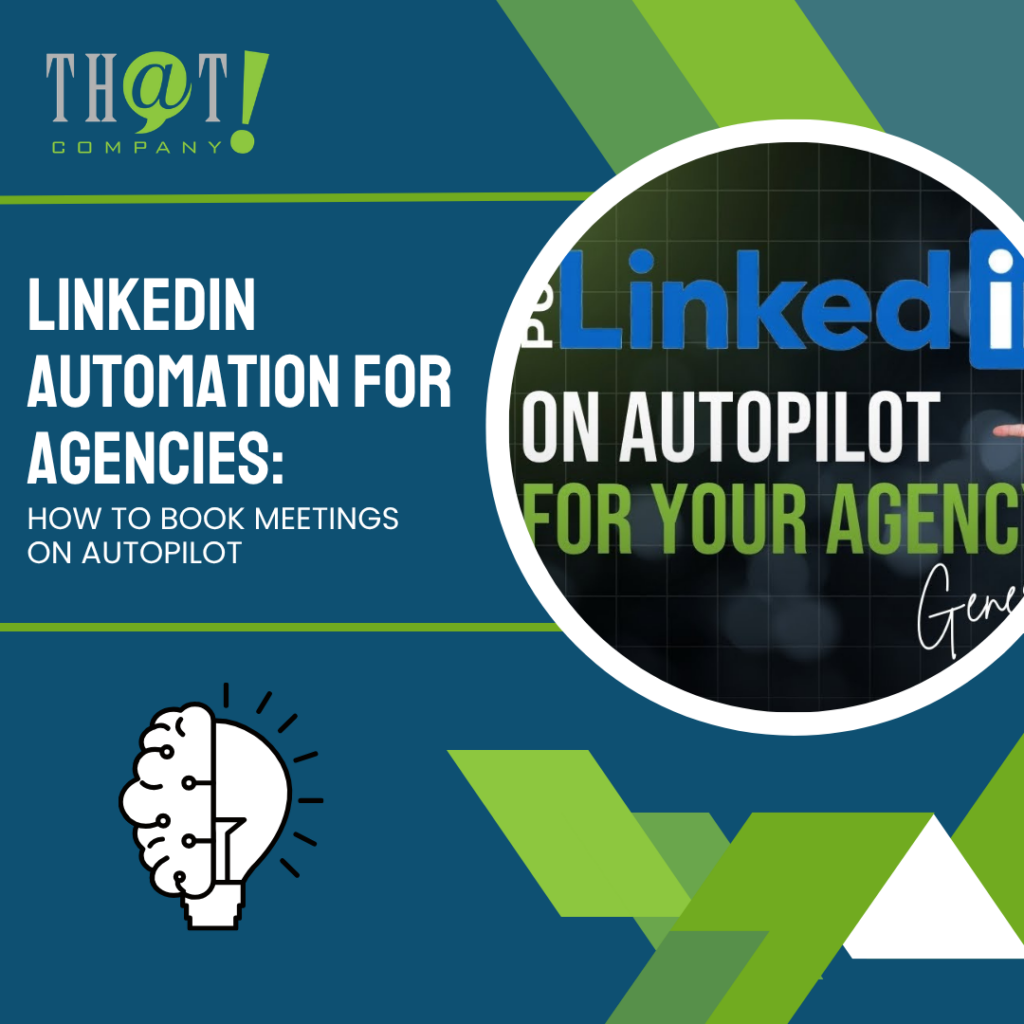
Consistent prospecting is one of those agency-growth activities everyone knows matters—and one of the easiest to push aside when client work gets busy. Sending connection requests, following up, and tracking conversations manually can quickly become another full-time job.
That is where LinkedIn automation for agencies can help. In this Mastermind session, we break down a practical system for using LinkedIn outreach to consistently start conversations with qualified prospects while keeping the relationship-building side of sales human.
The key distinction is important: the goal is not to automate relationships. It is to automate the repetitive work required to start more of the right conversations.
Why LinkedIn Automation Makes Sense for Agencies
Agency owners have limited time. Between client delivery, sales, hiring, reporting, and actually running the business, consistent outbound prospecting can easily fall to the bottom of the list.
LinkedIn automation helps solve the consistency problem.
The system discussed in the session combines LinkedIn Sales Navigator for prospecting with an outreach automation platform. The software handles connection requests and scheduled follow-ups. When someone responds, the automated sequence stops and a person takes over.
That gives an agency leverage without trying to automate the part of sales that actually requires a human.
As discussed in the session, there is something valuable about having a system working on your behalf even while you are sleeping.
For newer agencies in particular, LinkedIn outreach can also offer an accessible way to build an outbound pipeline before committing significant cash flow to additional marketing channels.
Successful LinkedIn Automation Starts With Targeting
There is one rule worth remembering before launching any automated campaign:
Junk in, junk out.
Automation makes your process faster. Unfortunately, that includes a bad process.
If your audience is poorly targeted, automation simply allows you to reach irrelevant prospects faster. That can hurt response rates, waste your team’s time, and make your outreach look like spam.
Instead, spend time filtering your prospect list before the first message goes out.
Depending on your ideal customer profile, you might narrow prospects by:
- Industry
- Company size
- Geography
- Job title
- Seniority
- Business type
- Relevant services or needs
The goal is not to build the largest possible list. It is to build a list containing people you would genuinely want to speak with if they replied tomorrow.
That matters because unqualified appointments are not really wins. They simply move wasted time from prospecting to your calendar.
How LinkedIn Automation for Agencies Works
The workflow demonstrated during the session starts with LinkedIn Sales Navigator.
First, create a targeted Sales Navigator search containing the prospects you want to reach. That audience can then be imported into the automation platform and assigned to a campaign.
The campaign can include a connection request followed by one or more messages after the connection is accepted.
The basic process looks like this:
- Define your ideal prospect.
- Build and filter the audience in LinkedIn Sales Navigator.
- Import those prospects into your automation platform.
- Create your connection request and follow-up sequence.
- Activate the campaign.
- Allow the software to handle repetitive outreach.
- Take over personally whenever someone responds.
That final step is what keeps the system human.
Once someone engages, the automation has accomplished its job. From there, you are having a conversation with a person—not moving a contact through a machine.
Keep LinkedIn Messages Short and Human
One of the biggest lessons from the campaign is also one of the simplest: you do not need to cram your entire sales pitch into a LinkedIn message.
In fact, doing so can work against you.
The connection request used in the campaign was essentially:
“I’d like to connect and learn more about you and your company.”
Simple. Friendly. No wall of text explaining every service the company provides.
After a prospect accepted the connection, the first follow-up invited them to a short networking conversation.
Another follow-up was essentially just:
“Thoughts?”
That simplicity is intentional.
A LinkedIn message does not need to close the deal. It needs to create enough interest and comfort for the person to take the next step.
If your first interaction looks like a brochure squeezed into a direct message, you are asking the prospect to do too much too soon.
Optimize Your LinkedIn Profile Before Automating Outreach
Your message is only part of what a prospect sees.
People can check your profile before deciding whether to accept your request. That makes your headline and profile positioning part of your sales process.
The session specifically emphasizes putting your value proposition into your LinkedIn headline.
Rather than relying exclusively on a title such as “CEO” or “Founder,” give prospects some immediate context about what you actually do and whom you help.
A strong profile should make it easy to understand:
- Who you serve
- What your agency does
- What value you provide
- Why someone in your target market might want to know you
This is particularly useful when running niche campaigns.
Your Agency Doesn’t Have to Niche Down—Your Campaign Can
One of the more useful strategic ideas from the session is separating your agency’s overall positioning from the positioning of an individual outreach campaign.
Your agency may work across several industries. That does not mean every LinkedIn campaign needs to target everyone.
You could create a campaign specifically for one industry and customize the targeting, profile messaging, and offer around that audience.
Run the campaign, collect data, and see what happens.
If it works, you have found something worth expanding. If it does not, adjust the offer or test another audience.
This allows agencies to benefit from niche-specific messaging without necessarily committing the entire company to a single vertical.
What a Real LinkedIn Outreach Campaign Produced
The session also shares results from a LinkedIn campaign run between April and June 2021.
Over those three months, the campaign sent 9,078 connection requests. Of those requests, 1,665 were accepted, producing an acceptance rate of approximately 18.3%.
More importantly, the campaign generated 61 appointments.
Seven of those appointments were with potential centers of influence—people who worked with agencies and could potentially create mutually beneficial referral relationships, podcast appearances, webinars, and other partnership opportunities.
Based on the numbers shared in the session:
- 9,078 connection requests were sent.
- 1,665 connections were accepted.
- Acceptance rate was approximately 18.3%.
- 61 appointments were generated.
- Request-to-appointment rate was approximately 0.67%.
- Accepted-connection-to-appointment rate was approximately 3.6%.
Those percentages illustrate why automation can be valuable.
Even when only a small percentage of total outreach becomes an appointment, working the same volume manually would require a substantial amount of repetitive effort.
What Did Those LinkedIn Meetings Cost?
At the time of the original campaign, the outreach was being managed through a done-for-you arrangement costing $1,000 per month.
Across three months, that meant a $3,000 investment.
With 61 appointments generated, the reported cost worked out to approximately $49.18 per appointment.
The session then explores what the economics might have looked like using the self-managed technology stack discussed in the presentation. At an estimated $200 per month, three months would equal $600 in software costs.
Using the same 61 appointments, that hypothetical software-only calculation would be approximately $9.83 per appointment, before accounting for the team’s time managing the campaign and responses.
The original campaign had also generated $7,275 in sales by the time its results were documented, with a reported 242% return on investment.
These results are useful as a real campaign example, not a promise of what every agency should expect. Targeting, market conditions, messaging, positioning, profile authority, follow-up, and sales ability can all change the economics.
The lesson is to measure the entire funnel and determine whether the numbers make sense for your agency.
Why Automation Changes the Math
Consider the 0.67% request-to-appointment rate.
Viewed alone, that number may not seem particularly impressive.
Now consider what was behind it: more than 9,000 connection requests and 61 resulting appointments.
Sending thousands of relevant connection requests and managing follow-up manually takes considerable time. Automation changes the equation because it allows repetitive tasks to happen consistently without requiring someone to click through every step.
This is why agency owners should look beyond a single conversion percentage.
Track metrics such as:
Connection Acceptance Rate
Are the right prospects accepting your requests?
Response Rate
Does your messaging encourage people to engage?
Appointment Rate
Are conversations becoming actual meetings?
Qualified Opportunity Rate
Are those meetings with people who could realistically become clients or valuable partners?
Revenue and Lifetime Value
Do the clients generated by the campaign produce enough long-term value to justify the investment?
A cheap meeting is not valuable when it is with the wrong prospect.
Quality still wins.
The Person Sending the Message Matters
Another variable worth testing is the profile behind the campaign.
The session notes that outreach from someone with a CEO or VP title may receive a different response than outreach from someone clearly identified as a sales representative.
That makes sense.
People evaluate the person behind a connection request as much as they evaluate the words inside it.
If your campaign is not performing, do not immediately assume your message needs rewriting. Look at the complete picture:
- Sender
- Profile
- Headline
- Target audience
- Offer
- Connection message
- Follow-up
- Meeting experience
Small improvements at several stages can be more valuable than endlessly rewriting one message.
Approach the Conversation With a Desire to Help, Not Sell
Getting the meeting is only half the job.
If your outreach promises a friendly networking conversation and you immediately launch into a hard sales pitch, you create a disconnect.
Instead, the approach described in the session is to genuinely learn about the other person.
Ask about their company. Understand what they are working on. Find out where they need help.
Sometimes there will be an obvious fit for your agency’s services. Great—continue that conversation.
Sometimes there will not.
You may still be able to provide a useful resource, make an introduction, or create a relationship that becomes valuable later.
The goal should be for someone to leave the conversation feeling that the meeting was worth their time, even if they did not buy anything.
That approach takes more patience than treating every LinkedIn connection like a transaction, but it also builds stronger professional relationships.
Automate the Process, Not the Relationship
This may be the most important distinction in the entire strategy.
Use automation for predictable, repetitive actions such as sending connection requests and scheduled follow-ups.
Do not use it as a substitute for human interaction.
Once someone responds, take over.
That prevents awkward situations where a prospect has already started a real conversation but continues receiving automated messages that clearly have nothing to do with what they just said.
Good automation should make your agency look more consistent, not less human.
LinkedIn Automation Can Be an Effective Starting Point for Agency Growth
For a newer agency with limited cash flow, the session positions LinkedIn automation and cold email as practical early-stage prospecting strategies.
The reasoning is straightforward: both can produce consistent outbound activity without requiring the same type of ongoing media investment as paid advertising.
As revenue grows, the agency can reinvest that cash flow into additional acquisition channels, including SEO and paid media.
The point is not that LinkedIn should replace every other marketing strategy.
It is that agencies need reliable ways to start conversations, and an automated outbound system can help build that foundation while the agency grows.
From LinkedIn Outreach to Community Building
The session closes with an interesting experiment.
Instead of using LinkedIn outreach solely to generate immediate appointments, the speaker was testing an industry-specific campaign designed to invite prospects into a Facebook group.
The thinking was that a community could create several additional opportunities.
Prospects joining the group could answer qualifying questions, including whether they were interested in a competitor analysis. The agency could continue nurturing members by regularly sharing useful content. And building a concentrated audience around one industry could create additional marketing opportunities over time.
At the time of the session, this strategy was still being tested, so no conversion results were available yet.
But the broader concept is worth considering.
Not every prospect needs to become an appointment immediately.
Sometimes the better strategy is to build an audience, provide ongoing value, and create multiple opportunities for the relationship to develop.
Key Takeaways for Agency Owners
LinkedIn automation works best when technology handles repetition and people handle relationships.
Before launching a campaign, get the fundamentals right:
- Carefully filter your target audience.
- Optimize your LinkedIn profile and headline.
- Keep connection requests and follow-ups short.
- Consider niche-specific campaigns and offers.
- Stop automation when someone engages.
- Enter networking conversations ready to help rather than immediately pitch.
- Measure appointments, qualified opportunities, revenue, and lifetime value—not just connection counts.
- Test, learn, and refine the campaign based on real results.
The objective of LinkedIn automation for agencies is not simply to send more messages. It is to create more qualified conversations without requiring you or your sales team to perform every repetitive step manually.
And when those conversations start producing more business, delivery needs to scale with sales.
A white label digital marketing partner can help your agency expand capacity without having to build every fulfillment function internally. At That! Company, we can also provide sales support and communicate directly with clients under your agency’s brand—giving you more time to work on your agency instead of constantly working in it.