Skip to content

Building a successful SaaS marketing agency rarely happens because of one brilliant campaign or one lucky client. More often, growth comes from years of learning what you do well, narrowing your focus, developing repeatable systems, building relationships, and eventually learning which opportunities deserve a “no.”
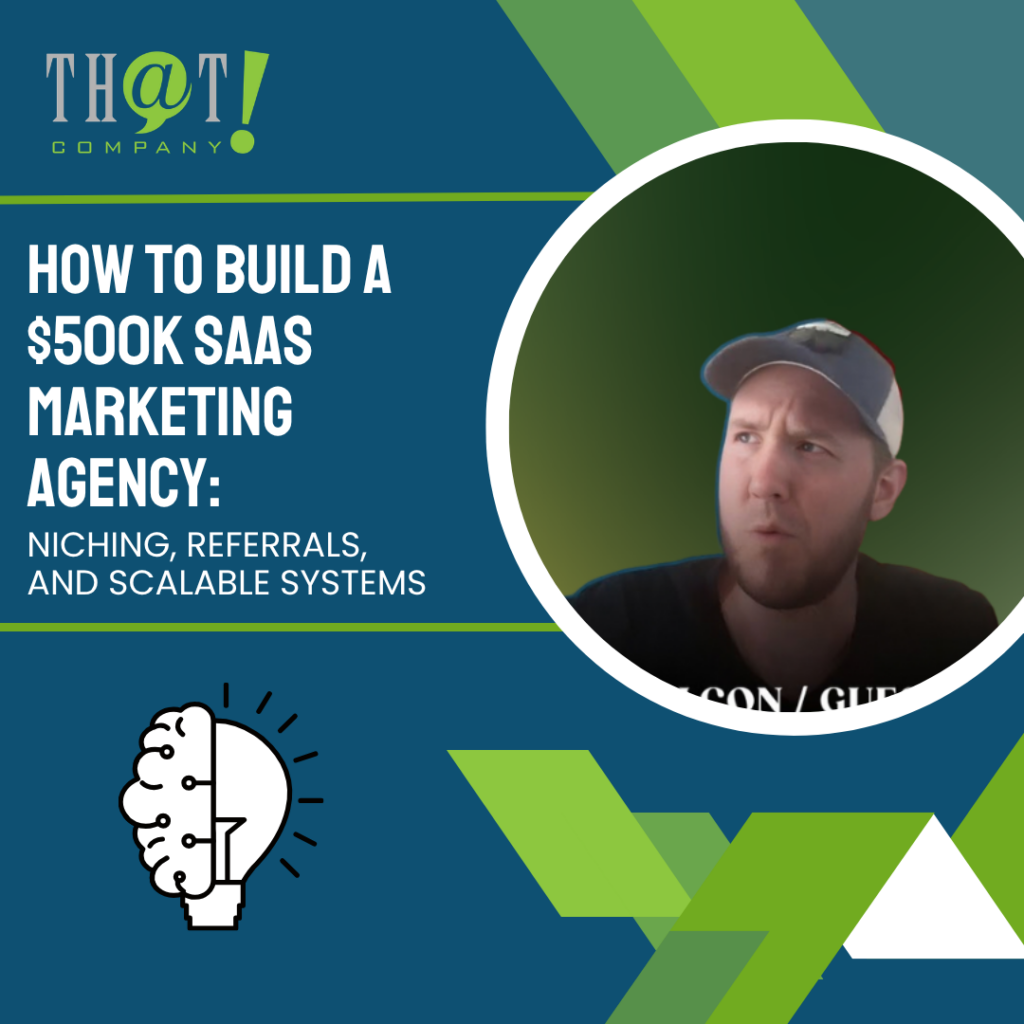
That journey is at the heart of this Agency Owner Mastermind conversation with Brandon Falcon, founder of Falconics. Brandon shared how he went from charging roughly $150 per month for organic social media services to building an agency focused on B2B software companies, with entry-level engagements around $3,200 per month at the time of the session.
For agency owners, his story offers something more useful than a shortcut: a look at how an agency business model can evolve as its owner becomes clearer about whom to serve, what to sell, and where their time creates the most value.
Prefer to watch? The full conversation is embedded below.
From $150 Clients to a Specialized SaaS Marketing Agency
Falcon officially started his agency in late 2014 after working in IT, corporate roles, sales, and marketing. He saw businesses with growth problems that couldn’t be solved by selling them one isolated solution.
So he started helping local businesses.
The agency’s early specialty was organic social media, with entry-level packages around $150 per month. It wasn’t glamorous, but those first clients gave Falcon an opportunity to develop skills, learn what businesses needed, and create a foundation.
One of those early clients—a painting company—was still working with the agency roughly eight years later when this session was recorded. Falcon said the agency had never raised that client’s original rate.
That detail says something important about sustainable agency growth: relationships matter alongside revenue.
The goal isn’t simply to replace every small client with a bigger one. It’s to understand which relationships helped build your business, which clients fit where you’re going, and how to grow without losing the service mentality that got you there.
Why Niching Changed the Agency’s Growth Strategy
Like many agency owners, Falcon initially believed serving everyone created the greatest opportunity.
Over the years, his team worked across fitness, e-commerce, medical businesses, nonprofits, landscaping, machinery, software, and other industries. The variety taught the team how to solve different problems—and, equally important, what kinds of work they didn’t want to do.
Eventually, the agency concentrated on B2B software companies.
Falcon explained that specialization allowed the team to create more finely tuned solutions instead of repeatedly starting from scratch.
You Don’t Necessarily Need to Niche on Day One
There is an important nuance here.
Working broadly early in an agency’s life can provide useful information. Different accounts expose your team to different business models, buyers, challenges, and channels.
Over time, patterns emerge:
- Which clients get your team excited?
- Where can you repeatedly produce meaningful results?
- Which buyers value what you do?
- Where can you charge enough to deliver the work properly?
- Which problems fit your team’s strongest capabilities?
Falcon’s agency experimented before settling on software.
In other words, niching wasn’t simply a marketing decision. It came from experience.

Build Your SaaS Marketing Agency Around the Problem, Not the Channel
One of the biggest changes in Falcon’s business was moving away from individual services toward an omnichannel approach.
Rather than selling only Facebook ads, SEO, or another standalone tactic, Falconics built programs that could combine SEO, organic social media, content, email campaigns, funnels, PR, paid social, paid search, reputation management, and lead generation.
The reasoning was practical.
If a client’s success depends entirely on one channel, a change to that platform can suddenly put the entire relationship under pressure. Managing multiple complementary channels creates more ways to adjust when performance shifts.
Falcon said his agency ultimately wanted to manage at least three channels so that if one encountered problems, the others could help offset the decline.
That’s a useful mindset for agencies regardless of niche:
Don’t just ask which service you can sell. Ask which combination of services solves the client’s actual growth problem.
The Referral Strategy That Generated 3–5 Leads Per Week
One of the most actionable lessons from the session had nothing to do with advertising.
It was referrals.
Before specializing in SaaS, Falcon’s agency leaned heavily on current clients, partners, and other relationships. At its peak, he said those efforts were producing roughly three to five referral leads per week—although the quality and fit of those leads varied widely.
His process was surprisingly simple.
1. Identify Clients Getting Great Results
Falcon would look for clients hitting meaningful milestones.
Rather than treating good performance as just another line in a report, he used the moment to strengthen the relationship.
2. Personally Celebrate the Win
He would personally contact the decision-maker—often with something as simple as a text—to acknowledge what they had accomplished together.
That matters.
A dashboard tells someone a number went up. A personal message tells them you noticed.
3. Ask While Enthusiasm Is High
After celebrating the success, Falcon would explain that his team enjoyed doing this type of work and wanted to help more companies like them.
Then came the ask: Do you know one or two other people we should talk to?
Falcon estimated that around seven out of ten clients approached this way would eventually provide at least one introduction. That’s his experience rather than a universal benchmark, but the broader lesson is valuable: don’t make referrals an awkward afterthought. Build the ask around genuine client success.

Build Relationships With People Who Already Know Your Ideal Clients
Client referrals were only part of Falcon’s growth engine.
As Falconics specialized, its referral partners became more specialized too.
The agency developed relationships with fractional CMOs, investors, marketing companies, and other people connected to software businesses.
A fractional CMO, for example, might develop the high-level strategy but need an experienced team to execute it. That creates a natural partnership rather than a forced referral arrangement.
The same principle applied to investors.
Falcon described showing investors how his agency could analyze a software company and identify potential marketing opportunities. That created value before asking for anything in return—and put the agency in proximity to the exact businesses it wanted to serve.
This is what That! Company often describes as developing centers of influence: relationships with people who may not buy from you themselves but regularly interact with people who could.
One strong center of influence can become more valuable than dozens of cold prospects because the relationship can produce multiple trusted introductions over time.
Why Referred Leads Can Be Easier to Convert
During the conversation, referrals were described as giving an agency access to an “invisible market.”
It’s a useful way to think about them.
Not every company that needs marketing help is currently searching Google, clicking an ad, or submitting forms to five agencies.
Some buyers aren’t actively shopping at all.
Then someone they trust says, “You should talk to these people.”
Suddenly, there’s a conversation.
The agency enters with trust that cold marketing has to work much harder to establish. And in some cases, the prospect hasn’t assembled a long list of competing agencies because they weren’t actively running a vendor search in the first place.
That doesn’t eliminate the need for a strong sales process. It simply changes where the conversation starts.
Your Best Clients Can Create More Than Referrals
A strong client relationship can create several growth opportunities.
During the session, the discussion highlighted four worth watching for:
- Referrals to similar businesses or decision-makers.
- Testimonials that strengthen your reputation.
- Case studies demonstrating what your process can accomplish.
- Expansion opportunities when another marketing channel could support the client’s goals.
The key is timing.
Quarterly and annual reviews aren’t just reporting meetings. When a client is happy and the numbers support the story, they can become strategic growth conversations.
Case Studies Don’t Always Need Famous Logos
Agency owners sometimes worry that they need recognizable client names before their case studies become persuasive.
Falcon took a different approach.
His agency often redacted identifying information while still sharing the underlying strategy, metrics, and results. That allowed the team to demonstrate its thinking without unnecessarily exposing client information or competitive details.
His point was straightforward: the result and your ability to explain how you produced it can matter more than the logo.
For a specialized agency, this becomes even more powerful because you can speak directly to the KPIs, challenges, and goals your prospects recognize.
A prospect doesn’t merely need evidence that you helped someone. They need to understand how your process applies to their problem.
The Hard Work Should Eventually Create Leverage
Falcon didn’t build the business on a four-hour workweek.
Early on, he described working roughly 14–16 hours a day, with that intense pace continuing for several years. Before leaving his corporate career, he and his then-girlfriend, now wife, saved enough money for approximately a year of runway.
According to Falcon, it took 367 days before the business became profitable enough to cover their bills.
But something changed as the agency matured.
He realized that simply adding more hours wasn’t necessarily producing better results.
Creativity, rest, delegation, and focusing his own time on high-value problems became more important. By the time of the interview, Falcon said he generally worked four to six hours per day and had previously spent extended periods traveling while working as little as roughly two hours on some days.
The difference was infrastructure.
At the time of the session, Falcon reported a team of 14 people—six U.S.-based employees and eight remote team members. The agency used that hybrid structure to keep work moving across different hours.
Agency freedom, in this example, wasn’t created by avoiding work. It came from eventually building systems and a team capable of doing more of that work without the founder personally touching every task.
Scale Revenue Without Scaling Overhead at the Same Rate
Falcon shared another revealing goal: grow the business significantly without allowing headcount and overhead to rise at the same rate.
That distinction matters.
Revenue growth alone doesn’t necessarily make an agency more scalable. If every new account requires proportionally more founder time, management, and labor, the business can simply become a larger version of the same operational headache.
The stronger question is:
How much additional infrastructure is required to serve the next client well?
That pushes agency owners toward documented processes, clearer roles, repeatable deliverables, better project management, and delegation.
It also encourages founders to stop asking, “How can I do more?” and start asking, “What should still require me at all?”
Find Your Superpower—Then Build Systems Around It
When asked for his biggest piece of advice for newer agency owners, Falcon returned to a theme that ran throughout the entire conversation:
Find what you’re good at.
Then build systems and services around it.
That applies to founders and teams.
Falcon said his own strength was solving complex problems. He wanted to enter situations that required creative thinking, develop a solution, and then hand execution to a capable team.
He encouraged his employees to think similarly. If someone no longer enjoyed a role or wasn’t working in an area that matched their strengths, the agency would look for opportunities to train or transition them.
“Find the things that you’re good at, find the things that your people are good at, [and] build everything around that.” — Brandon Falcon
Your agency doesn’t need to resemble every competitor.
In fact, trying to look like every competitor may be exactly what prevents you from becoming memorable.

Learning to Say No Is Part of Building a Better Agency
Early in his journey, Falcon said yes to almost everything.
Later, that changed.
Specialization made it easier to identify which opportunities belonged inside the agency and which should go to referral partners. It also made the team more comfortable walking away from clients whose requirements, expectations, or working styles didn’t align.
That’s an important stage of agency growth.
At the beginning, revenue can make almost every opportunity look attractive. As the business matures, the hidden costs become easier to recognize: excessive communication, poor strategic fit, work outside your systems, distracting one-off requests, or projects your team simply doesn’t enjoy.
Saying no isn’t about becoming difficult.
It’s about creating enough clarity to know what you’re actually building.
Key Takeaways for Building a SaaS Marketing Agency
Falcon’s path from inexpensive organic social packages to a specialized B2B software agency wasn’t built around one magic growth tactic. It was an accumulation of decisions.
He experimented broadly before niching. He shifted from individual tactics toward integrated solutions. He developed a repeatable referral process. He cultivated centers of influence. He built a team that reduced the agency’s dependence on his personal labor. And he became increasingly selective about which clients belonged in the business.
For agency owners, the larger lesson is simple: scale becomes easier when the business gets clearer.
Clearer about your ideal clients. Clearer about your strengths. Clearer about the problems you solve. Clearer about your systems. And clearer about what the owner should—and shouldn’t—still be doing.
That same principle applies when fulfillment becomes the bottleneck. With the right White Label Digital Marketing partner, an agency can expand its delivery capacity without having to build every department internally.
At That! Company, we can also support the sales process and communicate directly with clients under the agency’s brand. That gives agency owners more room to focus on generating opportunities, strengthening relationships, and working on their agency instead of spending all their time working in it.